Nuisance ant infestations across the Piedmont region involve distinct structural dynamics due to local red clay subsoils and sustained humidity. In established residential corridors like Augusta Road, Alta Vista, and…
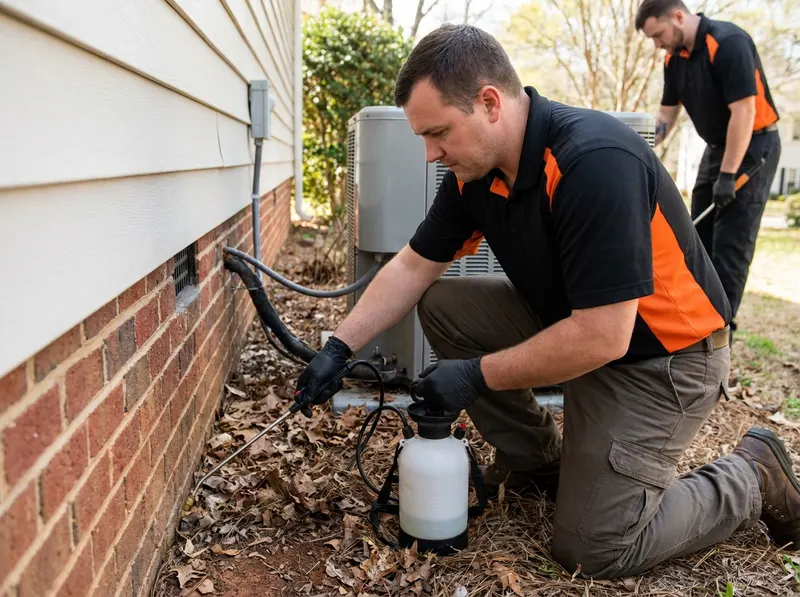
Nuisance ant infestations across the Piedmont region involve distinct structural dynamics due to local red clay subsoils and sustained humidity. In established residential corridors like Augusta Road, Alta Vista, and North Main, mature hardwood canopies drop moisture and organic debris directly against foundation perimeters. When property owners apply over-the-counter pyrethroid sprays to trailing workers, the chemical barrier triggers an ecological survival reaction known as colony budding. Species such as the North Carolina State Extension Entomology documented Argentine ant (Linepithema humile) and the odorous house ant (Tapinoma sessile) respond to surface repellents by splitting a single colony into multiple decentralized satellite units. This dispersal multiplies indoor foraging pressure along plumbing chases, kitchen subflooring, and window sills. Systematic elimination bypasses barrier repulsion in favor of slow-acting ingestion chemistry that worker ants transport past exterior wall voids and back to egg-laying queens.
Subterranean baiting and exclusion follow a calibrated deployment sequence to prevent re-entry. Step 1 establishes an initial perimeter trail audit around crawlspace vents, brick weep holes, and masonry joints within 30 feet of the primary structure. Step 2 requires moisture diagnostics using tools approved by the Clemson University Department of Pesticide Regulation to pinpoint damp framing around HVAC condensation lines and crawlspace access wells. Step 3 introduces non-repellent liquid actives and sugar-protein matrices formulated according to standards set by the United States Environmental Protection Agency. Step 4 applies targeted exterior micro-injections into exterior soil-to-slab interfaces. Step 5 completes physical exclusion by sealing perimeter foundation penetrations with elastomeric sealants compatible with technical standards from the National Pest Management Association.
Targeted colony elimination suits properties experiencing persistent indoor worker lines near baseboards or pantries, particularly in damp crawlspace homes common to Overbrook, Nicholtown, and Parkins Mill. When compared to routine broad-spectrum exterior treatments, targeted matrix eradication requires zero interior broadcast evacuation and eliminates the underground reproductive core rather than temporarily halting exterior workers. Properties bordering riparian zones like Falls Park on the Reedy, the Swamp Rabbit Trail, or the forested elevations near Paris Mountain State Park face higher baseline immigration from polydomous supercolonies. In these moisture-rich environments, perimeter landscape buffers require careful coordination with guidelines outlined by the United States Department of Agriculture to trim tree limbs 24 inches clear of roof shingles. Safe deployment of low-toxicity baits around domestic pets adheres to toxicological safety metrics recognized by the Centers for Disease Control and Prevention and animal welfare baselines from the American Society for the Prevention of Cruelty to Animals, preventing companion animal contact while maintaining full active efficacy against the nest.
Structural defenses remain durable through continuous compliance with the South Carolina Department of Health and Environmental Control environmental protection mandates and worker handling directives under the Occupational Safety and Health Administration. Addressing the structural source prevents repeated over-application of synthetic pesticides on residential properties near Botany Woods, Cleveland Forest, and Gower Estates. To verify site conditions and secure an exact on-site assessment, contact SilverOak Bug Elimination at (864) 215-5116.
Every job gets a firm, written price after an on-site visit.
Tell us about your nuisance ant colony elimination job in Greenville and we'll send a clear, written quote, usually the same day.
 SilverOak Bug Elimination